What Happens to Pokémon Card Prices During a Global Financial Crisis?
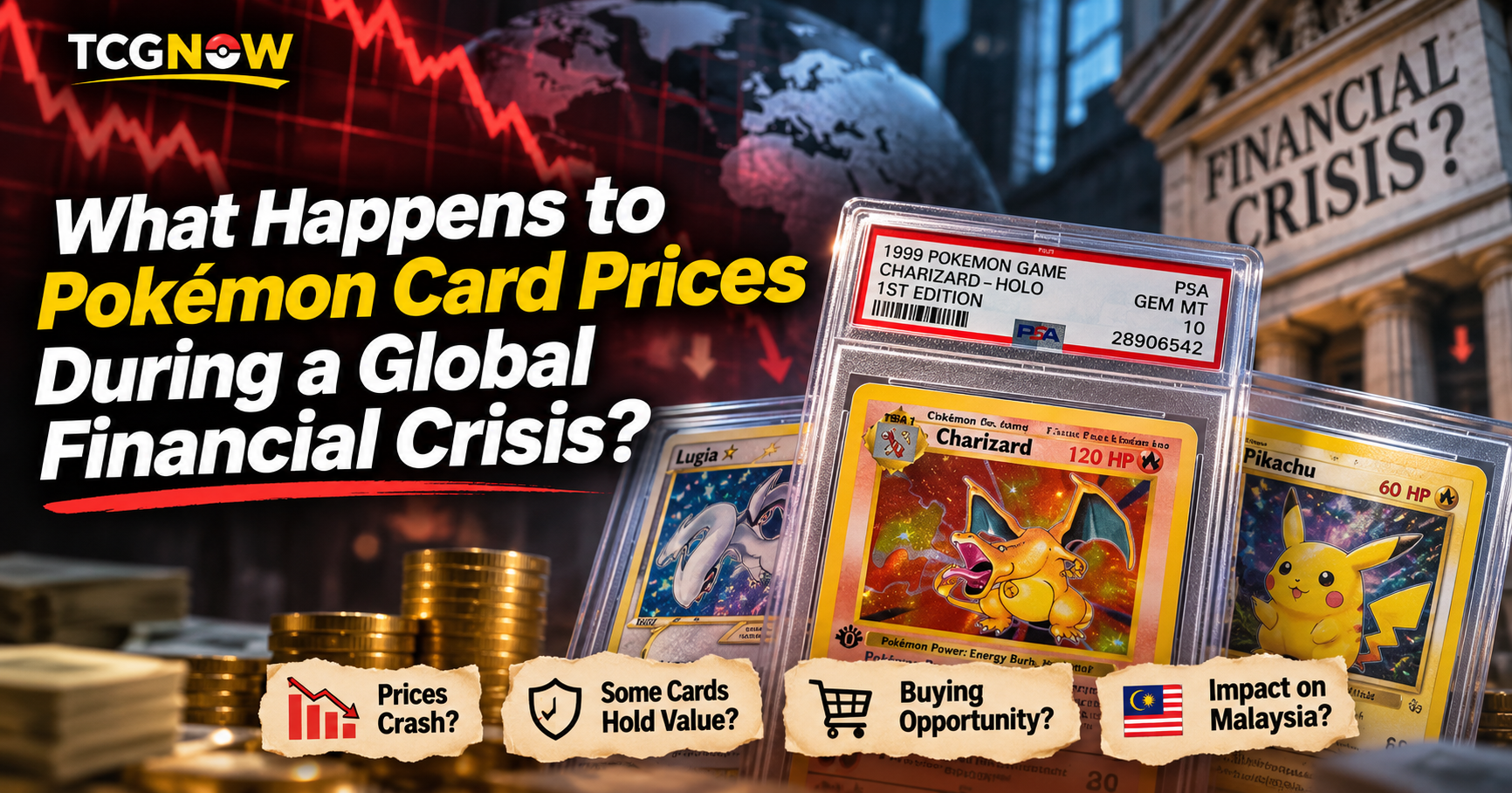
With governments encouraging emergency preparedness and growing discussions about a possible global financial crisis, people are becoming increasingly concerned about their financial future. But while most discussions focus on stocks, property, gold and cryptocurrencies, there’s another market worth examining: Pokémon trading cards.
Over the past few years, Pokémon cards have evolved into valuable collectibles, with rare cards selling for thousands or even millions of ringgit. Many collectors now view their collections as assets rather than simply a hobby.
But what happens when the global economy enters a serious downturn? Will Pokémon card prices crash, or could certain cards hold their value?
Why Pokémon Card Prices Could Fall During a Financial Crisis
Unlike essential goods, Pokémon cards are discretionary purchases. When people face financial uncertainty, spending RM5,000 on a PSA 10 Charizard becomes less important than paying bills, maintaining savings or protecting their businesses.
A financial crisis could affect the Pokémon market in two ways: fewer people buying and more people selling.
Imagine a collector with RM50,000 worth of Pokémon cards who suddenly loses their job. Instead of waiting for the right buyer, they might need to sell their collection quickly, even at a substantial discount.
Now imagine thousands of collectors facing similar circumstances.
More cards enter the market while buyers become increasingly cautious. Sellers begin lowering prices to attract interest, potentially triggering a broader market correction.
The biggest danger isn’t necessarily that Pokémon cards become less desirable. It’s that collectors may need to sell when fewer people can afford to buy.
This is known as liquidity risk, and it’s particularly important in the collectibles market.
Will Vintage, Modern and PSA 10 Cards React Differently?
Not all Pokémon cards are equal. During an economic downturn, different categories could experience very different levels of demand.
Modern Pokémon cards: Modern chase cards and special illustration rares often attract strong demand, but many are still being opened and graded. If demand weakens while supply continues increasing, prices could face additional pressure.
Modern PSA 10 cards: A perfect grade doesn’t automatically guarantee scarcity. Some modern cards already have thousands of PSA 10 copies. When collectors start selling, buyers may have plenty of alternatives.
Vintage Pokémon cards: Cards such as 1st Edition Base Set Charizard, Gold Star Rayquaza and Shining Charizard have historical significance and limited surviving supply. These characteristics may help sustain collector interest, although they cannot prevent prices from falling.
Rare trophy and promotional cards: Extremely limited Japanese tournament prizes may remain desirable among wealthy collectors. However, their high prices also mean finding a buyer could become more difficult during a crisis.
Sealed Pokémon products: Modern booster boxes and Elite Trainer Boxes could experience weaker demand if collectors reduce spending. Vintage sealed products have different supply characteristics, but they’re not immune to market corrections.
One lesson from the Pokémon collecting boom of 2020–2021 is that prices can increase rapidly when enthusiasm and spending rise. Subsequent corrections in parts of the market demonstrated that those valuations aren’t guaranteed to last.
The 2008 global financial crisis offers less reliable evidence because the Pokémon collectibles market was considerably smaller and historical sales data is limited.
Could a Financial Crisis Create Buying Opportunities?
Interestingly, a financial crisis could also create opportunities for collectors with sufficient savings.
Imagine a vintage PSA 10 card normally selling for RM10,000 suddenly becoming available for RM7,000 because its owner urgently needs cash.
For someone who has wanted that card for years, the lower price could be attractive.
However, there’s an important difference between buying a discounted collectible and buying something that will increase in value.
A card dropping from RM10,000 to RM7,000 could continue falling to RM5,000. Nobody knows exactly when a market will reach its lowest point.
Collectors should also remember that asking prices don’t always reflect actual market values. A card listed for RM10,000 isn’t necessarily worth RM10,000 if nobody is willing to pay that amount.
Completed sales, grading populations and genuine collector demand are more useful indicators than optimistic listing prices.
For long-term collectors, weaker market conditions could provide opportunities to acquire desirable cards. But purchasing collectibles with emergency savings or borrowed money introduces unnecessary financial risk.
What Could Happen to Malaysia’s Pokémon TCG Market?
Malaysia’s Pokémon market is closely connected to international markets, particularly Japan and the United States.
A global financial crisis could affect local collectors through weaker consumer spending, changing international card prices and currency fluctuations.
For example, imagine a Japanese Pokémon card falls 20% in value internationally. If the Malaysian ringgit weakens against the Japanese yen at the same time, Malaysian buyers might not enjoy the full price reduction.
Local market liquidity is another consideration.
A card valued at RM20,000 internationally doesn’t necessarily have a buyer willing to pay RM20,000 in Malaysia. During difficult economic conditions, finding buyers for expensive collectibles could become even more challenging.
We could also see changes in how collectors trade.
Some may shift towards affordable raw cards instead of expensive graded collectibles. Others might sell unused sealed products or consign portions of their collections to release cash.
Auction platforms could become increasingly relevant as collectors look for ways to sell their cards, although auction results would still depend on active buyer demand.
For TCGNOW, this raises an interesting possibility: a financial crisis could increase the number of cards available for sale while simultaneously reducing the prices buyers are willing to pay.
More transactions or listings wouldn’t automatically mean a healthier market.
Should Pokémon Collectors Be Worried?
A global financial crisis is not guaranteed, and nobody can reliably predict exactly how Pokémon card prices would react.
However, collectors can prepare without abandoning the hobby.
The most important consideration is whether your financial security depends on the value of your collection.
If you collect Pokémon cards because you enjoy them and have sufficient savings elsewhere, temporary price declines may not significantly affect your lifestyle.
But if most of your savings are tied up in expensive slabs and sealed products, a sudden market correction could create serious problems, especially if you need cash urgently.
Pokémon cards can be valuable collectibles, but they shouldn’t automatically be treated as recession-proof investments.
Final Thoughts
The Pokémon TCG market has grown significantly since the 2008 financial crisis. Today, professional grading, international auctions and investment-oriented collecting play a much larger role.
A future global downturn could become an important test of how resilient this modern market really is.
Some cards may experience substantial corrections, while others could maintain stronger demand because of their scarcity, history and collector appeal.
But one thing is worth remembering:
The biggest risk during a financial crisis may not be that your Pokémon cards lose their value. It’s that you might need to sell them when nobody is willing to pay what you think they’re worth.
At TCGNOW, we believe collecting should remain enjoyable, regardless of market conditions. Buy what you love, understand what you’re paying for, and never put your financial security at risk for a collectible.
What do you think? Would a global financial crisis cause Pokémon card prices to crash, or would it create the biggest buying opportunity in years?
Disclaimer: This article is for educational purposes only and does not constitute financial or investment advice. The scenarios discussed are hypothetical, not predictions.
Related Post

The Biggest Mistake New Pokémon Card Investors Are Making Right Now
Pokémon cards have become more than a hobby. Today, sealed boxes, PSA 10 slabs and [...]
Pokémon Market Is Heating Up Again: The Biggest Price Spikes This Week
If you’ve been watching the market closely, one thing is clear: The Pokémon TCG isn’t [...]