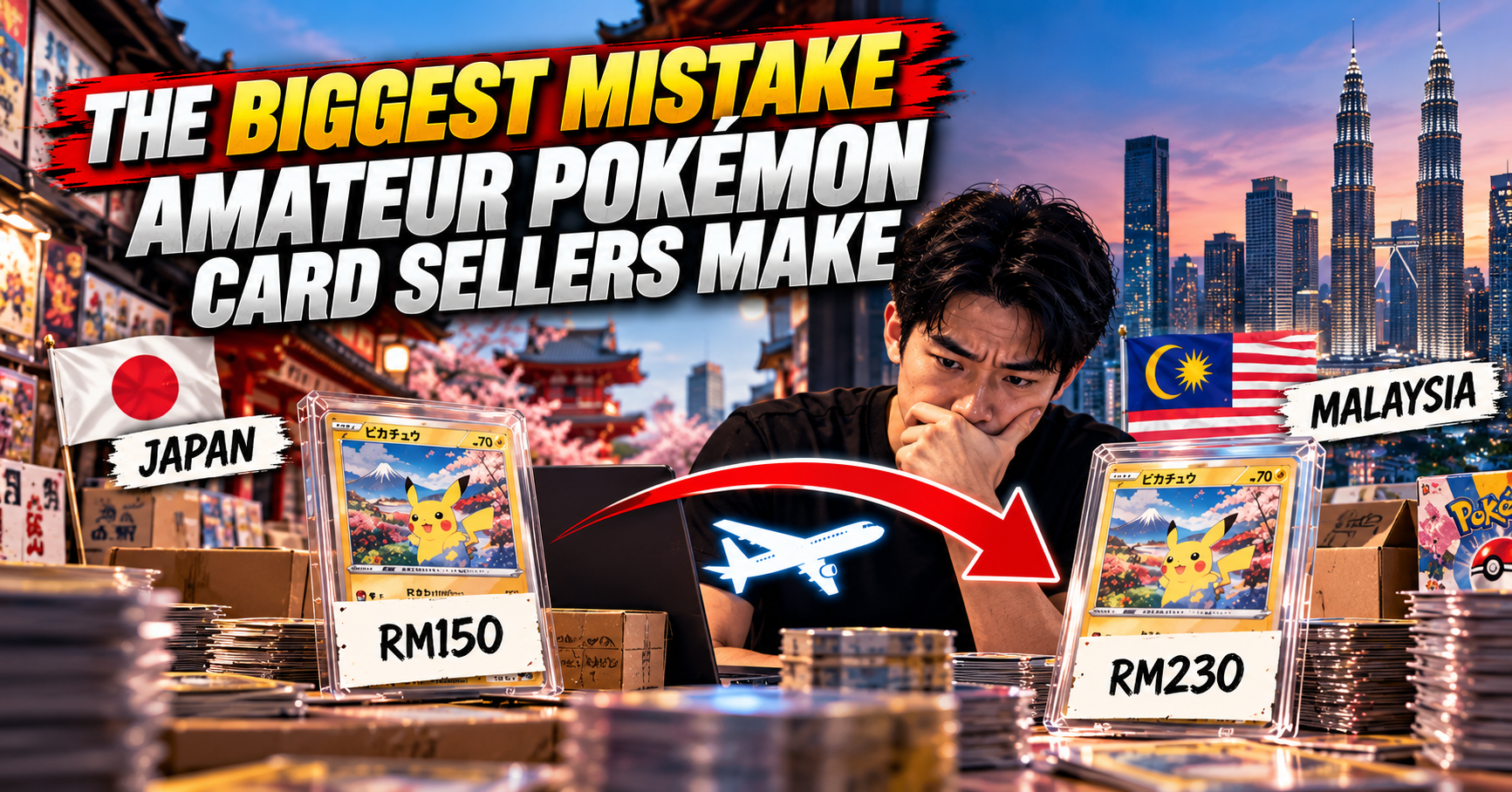
The Biggest Mistake Amateur Pokémon Card Sellers Make
When Pokémon card prices are going up, everybody wants to become a seller.
Buy a card for RM500, wait until it reaches RM800, sell it and pocket the difference. Sounds easy, right?
But what happens when prices stop climbing? Or worse, when the market starts falling?
Many amateur sellers assume there’s no money left to make.
That’s probably one of the biggest misunderstandings in the Pokémon card business.
You Don’t Need a Bull Market to Make Money
Here’s something worth understanding: making money from trading cards and making money from card prices increasing are two different things.
Collectors and investors often buy cards hoping they’ll appreciate over time. Sellers, on the other hand, can make money simply by purchasing inventory below its achievable resale price.
And that opportunity exists even when the overall market isn’t performing particularly well.
Take Japanese Pokémon cards, for example.
A card might be selling for RM150 in Japan but still have buyers willing to pay RM230 in Malaysia.
Why? Different demand, local availability, language preferences and the convenience of buying from someone locally.
That’s called price arbitrage — taking advantage of price differences between markets.
Let’s Look at a Simple Example
Imagine you’re sourcing Japanese Pokémon cards to resell in Malaysia.
| Item | Amount |
|---|---|
| Purchase price in Japan | RM150 |
| Allocated shipping and import costs | RM15 |
| Selling price in Malaysia | RM230 |
| Selling fees and packaging | RM15 |
| Estimated profit | RM50 |
| Return on total costs | 27.8% |
Illustrative example only. Actual margins depend on exchange rates, sourcing, taxes, platform fees and market demand.
You didn’t need the card to appreciate.
You simply bought it at a price that left enough room to resell it profitably.
Now imagine repeating that across 20 cards.
That’s RM1,000 in potential profit before other business overheads, assuming every card sells at the expected price.
Not bad for a market that’s supposedly going down.
The Real Problem Is Buying Without Knowing Your Exit Price
This is where many beginners get caught.
They see a card listed for RM500 and find someone selling it for RM400.
Immediately, they think they’ve found a bargain.
But have they?
What if the RM500 listing has been sitting there for three months?
What if completed sales are actually closer to RM380?
And what if local dealers are only willing to buy it for RM300?
Suddenly, that RM400 bargain doesn’t look so attractive anymore.
A cheap card isn’t necessarily a good deal. A profitable deal starts with knowing what someone will realistically pay you for it.
That’s why checking actual transactions matters much more than looking at the highest asking price.
Fast Turnover Can Beat Waiting for the Next Big Jump
Let’s compare two different approaches.
| Seller A | Seller B | |
|---|---|---|
| Strategy | Hold for appreciation | Buy and resell |
| Purchase cost | RM1,000 | RM1,000 |
| Target | Sell for RM1,500 | Sell for RM1,150 |
| Expected holding period | 12 months | 30 days |
| Main risk | Market price falls | Inventory doesn’t sell |
Seller A might make more on a successful trade.
But Seller B could potentially recycle the same capital multiple times throughout the year.
Of course, faster turnover isn’t guaranteed. Unsold stock, fees and unexpected expenses can quickly reduce profits.
Still, this is why many established trading card businesses focus on inventory turnover and consistent margins, rather than trying to predict the next card that will double in value.
Japan Isn’t Automatically Cheaper Either
There’s another mistake worth mentioning.
Some Malaysian sellers assume anything purchased directly from Japan must be profitable.
Not necessarily.
Japanese sellers understand market prices too. Popular cards can already be expensive, especially when overseas demand is strong.
Then you need to account for currency conversion, shipping, import charges, card condition and selling fees.
A RM20 price difference isn’t very useful if getting the card into Malaysia costs RM30.
The opportunity isn’t simply buying from Japan.
It’s finding the right card, at the right price, for the right buyer.
Sell, Profit, Restock, Repeat
Personally, I think this is a much healthier way to look at the Pokémon card business.
You don’t need to predict which Charizard will become the next RM10,000 card.
You don’t need every booster box to appreciate.
And you definitely don’t need to wait for another Pokémon hype cycle before making your next sale.
What you need is a repeatable process.
Find inventory people actually want. Understand the market price. Calculate your costs. Sell at a reasonable margin. Then use the money to restock.
Sounds less exciting than buying a card and watching it increase 300% overnight?
Definitely.
But a sustainable business is built on transactions, not predictions.
And that’s something amateur Pokémon card sellers should understand before spending thousands of ringgit building their inventory.
Related Post
Chaos Order Is Coming — Here’s Where Prices Are Actually Going
Chaos Order is already starting to show early pricing, and if you’ve been around long [...]
The Pokémon Grading Tier List Every Collector Learns Too Late
Most collectors think grading is simple. “10 is good. 9 is decent. Raw is cheaper.” [...]