The Pokémon Grading Tier List Every Collector Learns Too Late
Most collectors think grading is simple.
“10 is good. 9 is decent. Raw is cheaper.”
That’s usually how people start — until they see one Charizard selling for RM500, another for RM5,000, and a Black Label version for RM50,000.
Same card. Completely different market.
That’s when collectors realize grading is not just about condition anymore. It’s about scarcity, trust, status, liquidity, and how the market values perfection.
Over the years, Pokémon slabs have quietly developed their own hierarchy system, and understanding it early can completely change how you collect, buy, and invest.
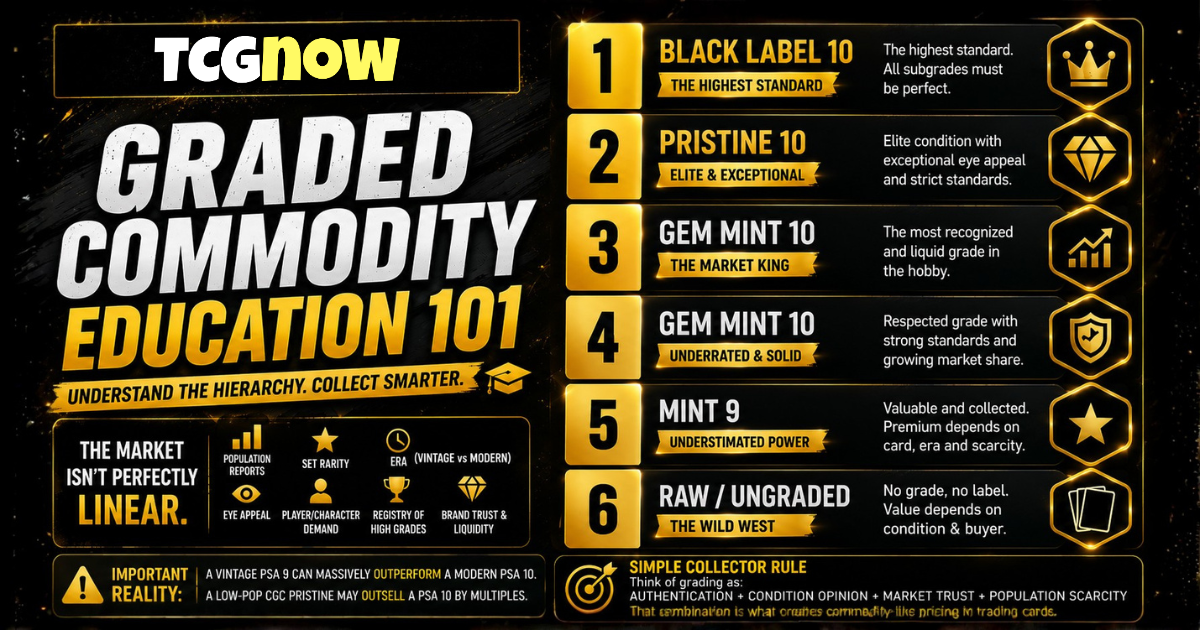
Tier 1 — BGS Black Label 10

This is the highest level most modern collectors chase. To receive a Black Label, the card must score perfect 10s across centering, corners, edges, and surface. Basically, everything must be flawless.
That rarity is why collectors go crazy over Black Labels. A normal PSA 10 might already be expensive, but a Black Label version can sometimes sell for multiple times more. Not because the artwork changes — but because perfection itself becomes the collectible.
For many serious collectors, this is considered the final boss of Pokémon grading.
Tier 2 — CGC Pristine 10

CGC Pristine slabs have gained huge respect recently, especially after CGC updated their labels. Many collectors see Pristine as the middle ground between PSA 10 and Black Label — stricter than PSA, but more achievable than Beckett perfection.
Low-population Pristine cards, especially popular Pokémon like Umbreon, Rayquaza, or Pikachu, have started commanding very strong premiums. Some collectors even prefer the look of CGC slabs over PSA entirely.
Tier 3 — PSA Gem Mint 10

PSA 10 remains the king of liquidity.
Whether you like PSA or not, the market trusts PSA more than any other grading company. Buyers understand it immediately, auction houses use it heavily, and sales data is everywhere.
That recognition matters.
A PSA 10 is often considered the safest grading position because it is the easiest to buy, sell, compare, and track long term. For many collectors, PSA is still the default standard of the Pokémon hobby.
Tier 4 — CGC Gem Mint 10

CGC Gem Mint 10 sits in a very interesting spot. It usually sells slightly below PSA 10 despite many collectors believing CGC can actually grade stricter in certain areas.
That creates opportunities.
Some collectors intentionally target CGC 10 slabs because they cost less while still offering strong condition standards and credibility. Modern collectors especially have started paying more attention to CGC over the past few years.
Tier 5 — PSA 9

This is where newer collectors often make mistakes.
Many people assume a PSA 9 is “bad.” In reality, vintage PSA 9 cards can massively outperform modern PSA 10 cards.
Why?
Scarcity.
Older cards are much harder to preserve in high condition. A PSA 9 Base Set Charizard is still considered an elite collector item because surviving copies are limited.
This is why experienced collectors study population reports, print history, and era scarcity instead of looking only at the grade number.
Not all 10s are valuable. And not all 9s are weak.
Tier 6 — Raw Cards

Raw cards are where most collectors begin. And honestly, some of the biggest opportunities still exist in raw cards.
Finding a clean raw card and successfully grading it into a PSA 10 can create huge value jumps. But raw buying is also risky because photos can hide whitening, scratches, dents, or print defects.
This is where experience matters the most.
The longer you collect, the more you realize grading is not just about condition — it is about market confidence.
The Biggest Thing New Collectors Miss
Not all PSA 10s are equal.
Some PSA 10 cards only have 50 copies in existence. Others have 25,000.
That difference completely changes long-term value.
A low-pop vintage PSA 10 behaves very differently from a mass-produced modern promo, even if both carry the same grade.
This is why serious collectors focus on:
- population reports
- rarity
- Pokémon popularity
- era
- demand
- and long-term collector appeal
—not just the number on the slab.
Final Thoughts
Grading transformed Pokémon cards from simple collectibles into structured assets with global market demand.
That’s why today you see:
- six-figure auctions
- investment portfolios
- vault storage
- international collectors
- and massive demand for high-grade cards
The hobby evolved far beyond childhood nostalgia.
And once you understand the grading hierarchy properly, the Pokémon market suddenly starts making a lot more sense.
Related Post
Why Pokémon Cards Are Becoming Real Assets (And Not Just Nostalgia)
A few years ago, most people looked at Pokémon cards as childhood memories. Today, that [...]
The Fake Card Problem Is Getting Worse — And Pokémon Is Now The Biggest Target
The Pokémon TCG market has grown into a billion-dollar global hobby, but with bigger money [...]